Shopping for a handheld car vacuum usually means comparing a wall of numbers: pascals, minutes, watts, filter grades. Most listings look impressive, and many look almost identical. The hard part is knowing which specs actually change how clean your car gets.
This guide explains how to choose a handheld car vacuum by walking through each spec in plain terms: what it measures, what it leaves out, and how much weight to give it. We sell our own car vacuum, so we will tell you where it fits, but the advice below applies to any model you are considering.
Start With How You Actually Clean Your Car
Before reading any spec sheet, picture your real routine. Are you picking up crumbs and sand after a beach trip? Pet hair from the back seat? Dust from vents and cup holders once a week? Or a full interior reset a few times a year?
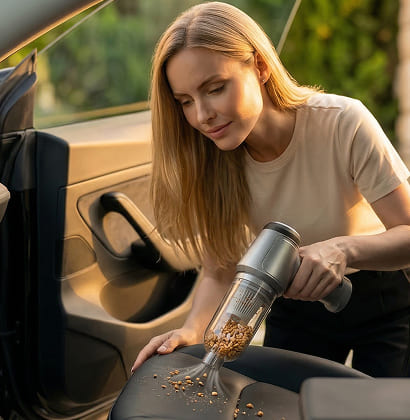
A small handheld is built for frequent, quick clean-ups: the five-minute pass that stops dirt from grinding into the carpet. If you mostly do occasional deep cleans, you may also want a larger machine for those sessions. Our step-by-step guide to deep cleaning your car interior shows where each tool fits.
Suction Power: What Pa Does and Does Not Tell You
Most car vacuums advertise suction in pascals (Pa), often written as kPa (1 kPa = 1,000 Pa). Pa measures pressure. Specifically, it is usually the maximum pressure difference the motor can create when the airflow is fully blocked, sometimes called sealed suction.
That number is useful, but it is not the whole story. Picking up debris depends on two things working together:
- Pressure (Pa): how hard the vacuum pulls. This helps lift heavier particles like sand and gravel from carpet fibers.
- Airflow: how much air moves through the nozzle. This carries lighter debris like dust, crumbs and hair into the bin.
A vacuum can post a high sealed-suction figure and still move relatively little air, which you would feel as weak pickup on loose debris. That is why some manufacturers publish air watts (AW) instead, a figure that combines pressure and airflow. In practice, few compact car vacuums list air watts, and you cannot convert Pa to air watts directly because they measure different things.
Why spec sheets are hard to compare
There is no single required test method for handheld car vacuums, so brands may measure suction differently. Some quote a peak number on the highest setting, some measure at the motor rather than at the nozzle, and some numbers are simply optimistic. Treat any suction figure, including ours, as a rough guide rather than a guarantee.
A few practical tips:
- Use Pa to separate broad classes of vacuums, not to rank two models that are a few thousand Pa apart.
- Check whether the figure applies to the top power mode only, and how long the battery lasts in that mode.
- Remember that a clogged filter or a poorly shaped nozzle can cut real-world performance far more than a small spec difference.
Motor Type: Brushed vs Brushless
Many newer handhelds use a brushless motor. Without carbon brushes rubbing inside, brushless motors tend to run more efficiently, generate less heat and wear more slowly than brushed designs of similar size. That efficiency matters in a small battery-powered tool, because more of the stored energy goes into moving air.
Motor type will not tell you everything about performance, but a brushless motor is a reasonable thing to look for in a cordless model.
Battery and Runtime
Runtime claims are almost always the maximum, measured on the lowest power setting. On a higher setting, expect noticeably less. When you compare listings, look for whether the runtime figure is stated as “up to” and which mode it refers to.
How much runtime do you need? For quick clean-ups, most people use a handheld in short bursts of a few minutes. A runtime in the range of 20 to 30 minutes on a normal setting usually covers several quick sessions or one thorough pass of the cabin between charges.
Also consider whether you even want a battery. Cordless models trade unlimited runtime for freedom from cords and outlets. We cover the trade-offs in detail in cordless vs corded car vacuums.
Charging: Why USB-C Matters
A vacuum you forget to charge is a vacuum you do not use. USB-C charging is a practical advantage because you can top it up from the same cables and adapters you already use for your phone: a car charger, a wall adapter at home or a power bank.
Proprietary barrel chargers work, but if the adapter is lost or left at home, the vacuum is out of action until you find it. Also check how long a full charge takes and whether the vacuum shows its battery level.
Filters: The Spec Most People Ignore
The filter decides two things: what goes back into the air you breathe in a closed cabin, and how well the vacuum keeps its suction over time. As a filter clogs with fine dust, airflow drops, and so does pickup.
Look for:
- A HEPA-type or multi-layer filter to trap fine dust instead of blowing it back out the exhaust.
- A washable filter, so you are not buying replacements every few months.
- Easy access, so emptying the bin and tapping out the filter takes seconds.
One honest note: a washable filter must be completely dry before it goes back in. Reinstalling a damp filter can trap moisture and reduce airflow. Many people keep the habit of rinsing it in the evening and leaving it out to dry overnight.
Nozzles and Attachments
Nozzle design is where a lot of real-world cleaning performance comes from. A narrow opening concentrates airflow, which helps in tight spaces. A wider opening covers more area per pass. Car interiors need both.
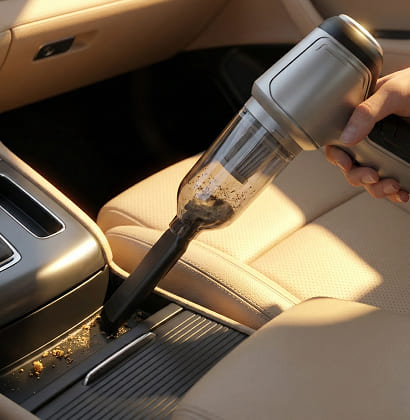
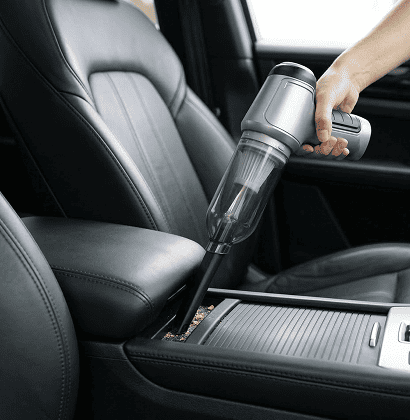
- Crevice nozzle: for the gaps between seats and the center console, seat rails and door pockets.
- Brush nozzle: for air vents, dashboards and floor mats, where bristles loosen dust and hair before the airflow carries it away.
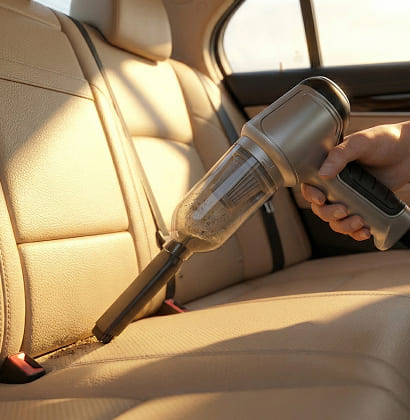
- Wide nozzle: for seat cushions, the trunk floor and other larger flat surfaces.
More attachments are not automatically better. Three well-designed nozzles you actually use beat eight that stay in a drawer.
Noise
All vacuums make noise, and compact ones can sound sharper because the motor spins fast in a small housing. Few car vacuums publish a decibel rating, and when they do, measurement distance varies. If noise matters to you, for example if you clean with a sleeping child nearby or late in a parking garage, read owner comments about sound and remember that higher power modes are usually louder.
Weight, Size and Storage
A handheld spends most of its life in a trunk, a glove box or a garage shelf. If it is awkward to grab, it will not get used. Check the weight and grip, especially if you will hold it overhead to clean headliners or reach under seats.
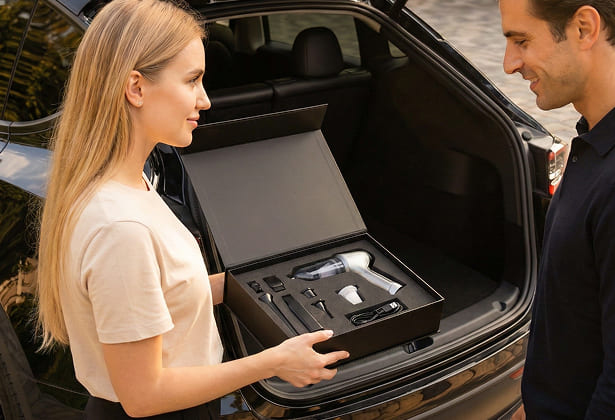
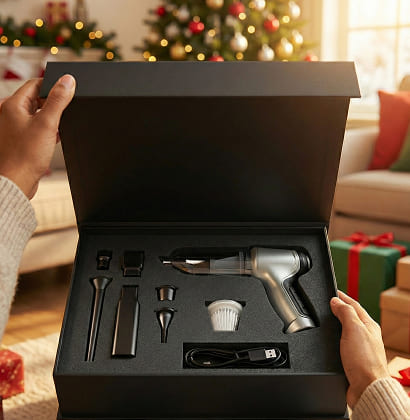
Storage is easy to overlook. Loose nozzles roll around a trunk and get lost. A case or box that holds the vacuum and its attachments in fixed places keeps everything together and ready. For more on why a compact vacuum earns a permanent spot in the car, see why a mini handheld vacuum is a must-have.
Quick Checklist: What to Look For
- Suction stated clearly in Pa (or air watts), with an understanding that it is one factor, not the full picture
- A brushless motor for efficiency in a cordless design
- Runtime that matches your routine, with the power mode stated
- USB-C charging that works from your car, home and a power bank
- A washable, multi-layer or HEPA-type filter that is easy to remove
- A crevice, brush and wide nozzle for gaps, vents and larger surfaces
- A comfortable weight and grip for one-handed use
- Storage that keeps the vacuum and nozzles organized in the car
How Otopulito Fits These Criteria
Here is how our own vacuum lines up against the checklist, stated as plainly as we can:
- Suction: 12,000 Pa from a brushless motor. As explained above, treat this as one useful indicator alongside nozzle design and filter care.
- Runtime: up to 30 minutes per charge.
- Charging: USB-C, so it charges from a car charger, a home adapter or a power bank.
- Filter: a washable dual-layer HEPA filter. Rinse it, then let it dry fully before reuse.
- Nozzles: a crevice nozzle for narrow gaps, a brush nozzle for vents and mats, and a wide nozzle for larger surfaces.
- Storage: a hard-cover magnetic gift box with custom foam slots that keep each part organized in the trunk.
It is designed for quick everyday clean-ups rather than heavy full-house cleaning. If that matches how you use your car, you can see Otopulito on Amazon. You can also learn more on the Otopulito home page.
Frequently Asked Questions
How many Pa of suction does a car vacuum need?
There is no official minimum, and figures from different brands are not always measured the same way. For everyday crumbs, dust and hair, nozzle design, airflow and a clean filter matter as much as the headline Pa number. Use Pa to compare broad classes of vacuums rather than to pick between two close models.
Are air watts better than Pa for comparing vacuums?
Air watts combine pressure and airflow, so in principle they give a fuller picture than Pa alone. In practice, few handheld car vacuums publish air watts, and test methods still vary. You cannot convert one unit into the other.
Why does my car vacuum lose suction over time?
The most common cause is a clogged filter or a full dust bin, both of which restrict airflow. Empty the bin after each use and clean the filter regularly. If the filter is washable, let it dry completely before putting it back.
Is a handheld car vacuum enough to clean my whole car?
For regular upkeep, usually yes, especially with a crevice, brush and wide nozzle. For heavy jobs like shampooing carpets or removing deeply embedded dirt, you may want a larger machine alongside it.
The Bottom Line
Choosing a handheld car vacuum comes down to matching the tool to your routine. Read suction numbers with healthy skepticism, check the runtime mode, favor convenient charging and a washable filter, and make sure the nozzles fit the spots in your car that collect dirt.
If you have questions about any of these specs or about our vacuum, get in touch with us. We are happy to give you a straight answer.